

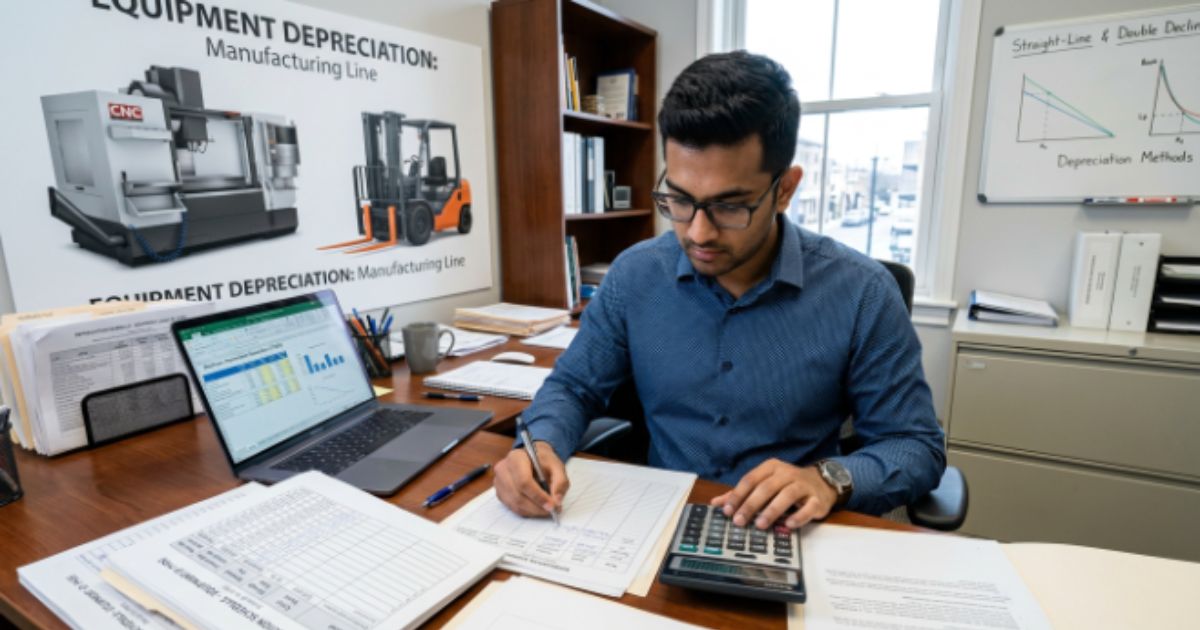
Calculating depreciation on equipment helps businesses understand how an asset loses value over time. It gives you a clearer view of costs, profits, and future equipment needs. By tracking equipment depreciation, you can estimate the book value of machinery and plan for repairs or replacement. Factors such as the original purchase price, useful life, salvage value, and equipment usage all affect the final calculation. Common methods include straight-line depreciation, units of production depreciation, and accelerated approaches.
Accurate calculations also support better asset management and financial planning. Whether you manage construction equipment, rental machines, vehicles, or office assets, understanding depreciation helps you make smarter buying, selling, financing, and replacement decisions while keeping financial records accurate.
What Is Equipment Depreciation and Why Does It Matter?
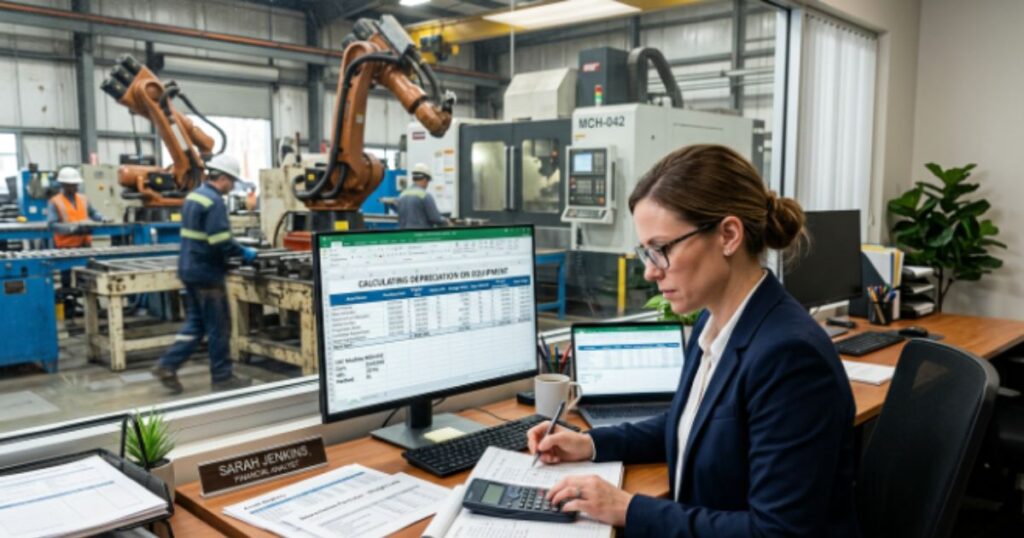
Equipment depreciation is the systematic recognition of an asset’s cost over its useful life. In simple terms, it represents the loss in asset value or loss of value over time associated with using an asset. A business doesn’t normally treat a long-term equipment purchase like an everyday expense. Instead, it recognizes the cost over the periods that benefit from the equipment.
Think of depreciation like slicing a large expense into smaller pieces. If a company buys a machine for $60,000 and expects to use it for five years, recognizing the entire $60,000 as an expense immediately may not reflect how the machine supports the business. Under a simple straight-line example, the business could recognize $10,000 of depreciation each year if the machine has a $10,000 salvage value. That annual depreciation expense helps match the equipment’s cost with the revenue it helps generate.
Depreciation also forms part of asset depreciation and fixed asset depreciation accounting. It affects the asset’s book value, which is the amount recorded on the balance sheet after accumulated depreciation. The book value may decline even when the equipment’s actual market value moves differently. For example, a five-year-old excavator could have a relatively low book value while still selling for a strong price because construction demand remains high.
The difference matters because depreciation isn’t simply a prediction of what you could sell the equipment for today. It is an accounting measurement. The IRS also treats depreciation as a method of recovering the cost or other basis of qualifying business property over time.
Equipment Depreciation vs. Market Value
Equipment depreciation and equipment market value answer different questions. Depreciation asks how much of the asset’s recorded cost has been allocated as an expense. Market value asks what a buyer may actually pay for that equipment today.
For example, imagine a contractor purchases an excavator for $150,000. After several years, the accounting records may show a book value of $70,000. Yet the machine could sell for $90,000 because demand for that model is strong. In another situation, poor maintenance and high operating hours could push its actual selling price below book value.
This difference becomes especially important when you’re planning equipment replacement. A depreciation schedule can tell you what the asset is worth on your books. It doesn’t automatically tell you whether today is the best time to sell it.
What Factors Determine Equipment Depreciation?
Several factors shape an equipment depreciation calculation. The most important starting points are the original equipment cost, useful life, and salvage value. Together, these determine how much value you expect to allocate over the asset’s depreciable period.
The initial asset value generally starts with the equipment’s acquisition cost. Depending on the accounting framework and circumstances, the recorded cost can include certain costs necessary to acquire and prepare the asset for use. The useful life of equipment describes the expected period during which the business will use the asset. Its equipment lifespan can depend on expected operating conditions, maintenance, technology, and physical wear.
Salvage value represents the expected amount the business could recover at the end of the asset’s useful life. Another useful term is estimated residual value. If a $60,000 machine is expected to have a $10,000 residual value after five years, the depreciable value is $50,000 under a simple straight-line calculation.
Usage matters too. A machine that operates 3,000 hours every year may experience much more equipment wear and tear than a similar machine that runs only 500 hours. That makes equipment usage and operating hours especially important when evaluating heavy machinery.
Maintenance also plays a role in the real-world condition of equipment. Regular equipment maintenance, preventive maintenance, and proactive maintenance can help keep machinery productive and may support a stronger resale position. However, good maintenance doesn’t necessarily change the accounting depreciation method or automatically extend the tax recovery period.
The Three Key Inputs in an Equipment Depreciation Formula
The basic depreciation formula starts with three core numbers: cost of equipment, salvage value, and useful life. The cost tells you how much the asset represents in your records. Salvage value estimates what remains at the end. Useful life tells you how long you expect to allocate the depreciable amount.
For example, suppose a business purchases construction equipment for $80,000. It expects the machine to have a $20,000 salvage value after 10 years. Its simple depreciable basis would therefore be $60,000. If straight-line depreciation applies, the annual amount would be $6,000.
| Depreciation Input | Example |
| Cost of equipment | $80,000 |
| Salvage value | $20,000 |
| Useful life | 10 years |
| Depreciable value | $60,000 |
| Annual depreciation | $6,000 |
These numbers are only an accounting example. Actual U.S. tax depreciation can use different rules, recovery periods, conventions, and elections.
How to Calculate Depreciation on Equipment
The easiest starting point for calculating depreciation on equipment is the straight-line formula. It spreads the depreciable cost evenly across the asset’s estimated useful life.
Depreciation Formula:
(Equipment Cost − Salvage Value) ÷ Useful Life = Annual Depreciation Expense
Suppose a company purchases equipment for $60,000. It estimates a salvage value of $10,000 and a useful life of five years. First, subtract $10,000 from $60,000. That leaves $50,000 of depreciable cost. Divide $50,000 by five years, and the annual depreciation amount becomes $10,000.
| Calculation | Result |
| Equipment cost | $60,000 |
| Less: salvage value | $10,000 |
| Depreciable cost | $50,000 |
| Useful life | 5 years |
| Annual depreciation | $10,000 |
| Monthly depreciation | $833.33 |
After the first year, the book value reduction would be $10,000. The beginning book value is $60,000 and the ending book value becomes $50,000. After the second year, accumulated depreciation becomes $20,000 and the ending book value becomes $40,000.
The calculation becomes even more useful when you create a full depreciation schedule. Instead of looking at one annual number, you can see how the asset’s value changes over its entire accounting life.
Equipment Depreciation Calculation Example
Consider a landscaping company that buys a commercial mower for $30,000. The company expects to use it for five years and estimates a $5,000 salvage value. Its depreciable cost is $25,000.
Using the straight-line method, the company records $5,000 of annual depreciation. The first year’s beginning book value is $30,000 and its ending book value is $25,000. By the fifth year, accumulated depreciation reaches $25,000 and the ending book value reaches the $5,000 estimated salvage value.
| Year | Beginning Book Value | Annual Depreciation | Accumulated Depreciation | Ending Book Value |
| 1 | $30,000 | $5,000 | $5,000 | $25,000 |
| 2 | $25,000 | $5,000 | $10,000 | $20,000 |
| 3 | $20,000 | $5,000 | $15,000 | $15,000 |
| 4 | $15,000 | $5,000 | $20,000 | $10,000 |
| 5 | $10,000 | $5,000 | $25,000 | $5,000 |
This example shows the basic logic behind calculating equipment depreciation. The business doesn’t claim that the mower literally loses exactly $5,000 of market value every year. Instead, the accounting method allocates its depreciable cost evenly across five years.
What Are the Main Methods for Calculating Equipment Depreciation?
Businesses can use different equipment depreciation methods depending on the accounting purpose and the nature of the asset. Straight-line depreciation spreads the depreciable cost evenly. Declining balance depreciation recognizes more depreciation earlier in the asset’s life. Units of production depreciation connects depreciation to actual usage or output.
The right method depends on what you’re trying to measure. A machine that provides fairly consistent service each year may work well with a straight-line approach. A machine that loses more value during its early years may be better represented by an accelerated approach for certain accounting purposes. Equipment whose wear closely follows operating hours may fit a usage-based method.
For U.S. federal income tax purposes, don’t assume these financial accounting methods automatically apply. The IRS says most depreciable business property placed in service after 1986 generally uses MACRS. Taxpayers may also have options such as Section 179 and special depreciation allowances when the property qualifies.
| Method | Basic Idea | Typical Use |
| Straight-line depreciation | Equal expense over useful life | Consistent-use assets |
| Units of production depreciation | Expense follows actual usage | Usage-driven machinery |
| Double-declining balance depreciation | Higher expense earlier | Assets with faster early value loss |
| Declining balance depreciation | Accelerated depreciation | Assets with front-loaded value loss |
| Sum-of-the-years’-digits | Accelerated allocation | Certain accounting situations |
Straight-Line vs. Units of Production vs. Double-Declining Balance
The biggest difference is timing. The straight-line method produces the same depreciation expense in each period. The units of production method changes with actual usage. The double-declining balance method produces a larger expense during the early years and a smaller expense later.
Imagine two identical machines. One runs all year while the other sits unused for months. A usage-based approach can show a larger expense for the heavily used machine. A straight-line approach would generally recognize the same annual amount for both if their cost, salvage value, and useful life were the same.
How to Calculate Equipment Depreciation Using the Straight-Line Method
Straight-line depreciation is often the simplest way to understand equipment depreciation. The method divides the depreciable cost equally across the asset’s useful life. It works especially well when the equipment provides relatively consistent benefits throughout that period.
The calculation is straightforward. Subtract the salvage value from the equipment’s cost. Then divide the result by its useful life. If a machine costs $100,000, has a $20,000 salvage value, and has a 10-year useful life, the annual depreciation is $8,000.
| Straight-Line Input | Amount |
| Original cost | $100,000 |
| Salvage value | $20,000 |
| Depreciable cost | $80,000 |
| Useful life | 10 years |
| Annual depreciation | $8,000 |
| Monthly amount | $666.67 |
The method is easy to maintain because the annual amount remains constant. That makes budgeting simpler and helps businesses build consistent financial statements. Still, simplicity has a trade-off. Real equipment doesn’t always lose economic value in a perfectly straight line.
Straight-Line Depreciation Example for Construction Equipment
Imagine a contractor buys a skid steer for $80,000. The company estimates a $20,000 salvage value after 10 years. Under a simple straight-line accounting example, the depreciable amount is $60,000.
Divide $60,000 by 10 years and the annual depreciation becomes $6,000. If the company uses the machine throughout the year, the book value falls by $6,000 annually under this simplified schedule.
The machine’s actual equipment resale value may not fall at exactly the same pace. A well-maintained skid steer with low hours could command a strong trade-in value even after several years. That is why depreciation records and market research should work together rather than being treated as the same thing.
How Does the Units of Production Method Work for Equipment?

The units of production method is a form of depreciation based on usage. Instead of assuming that every year creates the same amount of wear, it connects depreciation to measurable output. For heavy machinery, that measurement may be operating hours. For manufacturing machinery, it could be units produced.
The formula is:
(Cost − Salvage Value) ÷ Total Expected Units × Actual Units of Usage = Depreciation Expense
Suppose a $80,000 machine has a $20,000 salvage value and an expected useful output of 10,000 operating hours. The depreciable amount is $60,000. Divide that amount by 10,000 hours and the depreciation per hour becomes $6.
If the machine operates for 1,200 hours during a year, the depreciation expense would be $7,200. If it operates for only 500 hours the following year, the expense would fall to $3,000. That makes this approach useful when equipment’s wear closely follows machine operating hours.
Units of Production Depreciation Example
Consider a construction equipment rental company that owns a skid steer for $50,000. The expected salvage value is $10,000 and total expected use is 5,000 hours. The depreciable amount is $40,000.
Divide $40,000 by 5,000 expected hours and the depreciation rate becomes $8 per operating hour. If customers use the skid steer for 800 hours during the year, the calculated depreciation expense is $6,400.
| Measurement | Example |
| Equipment cost | $50,000 |
| Salvage value | $10,000 |
| Depreciable cost | $40,000 |
| Total expected units | 5,000 hours |
| Depreciation per hour | $8 |
| Actual units of usage | 800 hours |
| Annual depreciation | $6,400 |
This approach can be especially useful for construction equipment rental, manufacturing, and other operations where equipment utilization varies significantly. Accurate equipment tracking and asset tracking become important because poor usage data can weaken the calculation.
How to Create an Equipment Depreciation Schedule
An equipment depreciation schedule records how an asset’s carrying value changes over time. It normally shows the asset’s cost, depreciation expense, accumulated depreciation, and ending book value for each period.
A good depreciation schedule makes the numbers easier to audit and understand. It can also support equipment asset management because you can see which assets are approaching the end of their expected accounting life. When you maintain records for dozens or hundreds of machines, this becomes far more useful than trying to remember each asset manually.
The schedule below uses the $60,000 equipment example with a $10,000 salvage value and five-year useful life.
| Year | Beginning Book Value | Depreciation Expense | Accumulated Depreciation | Ending Book Value |
| 1 | $60,000 | $10,000 | $10,000 | $50,000 |
| 2 | $50,000 | $10,000 | $20,000 | $40,000 |
| 3 | $40,000 | $10,000 | $30,000 | $30,000 |
| 4 | $30,000 | $10,000 | $40,000 | $20,000 |
| 5 | $20,000 | $10,000 | $50,000 | $10,000 |
Sample Equipment Depreciation Schedule
The beginning book value shows the recorded value at the start of the period. The depreciation expense shows the amount recognized during that period. Accumulated depreciation represents the total depreciation recognized since the asset entered service.
The ending book value is generally calculated by subtracting accumulated depreciation from the asset’s recorded cost, subject to the applicable accounting framework and assumptions. A schedule like this provides a clear record of the asset’s asset lifecycle.
For a larger equipment portfolio, businesses can add purchase date, serial number, location, department, depreciation method, useful life, salvage value, and disposal date. That creates a more complete asset management record.
How Does Equipment Depreciation Affect Resale Value and Business Finances?
Depreciation can influence many business decisions even though it doesn’t directly determine an asset’s selling price. Equipment resale value depends on the real market. Buyers look at age, hours, condition, maintenance records, brand reputation, demand, attachments, and current financing conditions.
That means true resale value can differ sharply from book value. A machine may be almost fully depreciated on the accounting records but still have meaningful used equipment value. Conversely, an older machine with poor maintenance and extensive repairs may sell for less than its book value.
The connection becomes even more important when you evaluate equipment profitability. If a machine costs $15,000 a year to operate, generates $35,000 in annual revenue, and carries a $6,000 annual depreciation expense, its accounting profit picture differs from a simple revenue-minus-fuel calculation.
Depreciation also belongs in broader financial planning. When you compare ownership with leasing, include depreciation alongside financing, maintenance, insurance, fuel, repairs, downtime, and other ownership costs. This creates a clearer total cost of ownership picture.
For tax purposes, U.S. rules can be different from book accounting. The IRS states that qualifying property can generally be depreciated when it is owned, used in a business or income-producing activity, has a determinable useful life, and is expected to last more than one year.
Current tax rules also include Section 179 and special depreciation provisions for qualifying property. For 2026, IRS Publication 946 lists a $2.56 million maximum Section 179 deduction with a $4.09 million phaseout threshold for qualifying property placed in service during the year. Certain qualifying property acquired and placed in service after January 19, 2025 may also qualify for a 100% special depreciation allowance under current rules.
Because tax rules can change and depend on the asset and taxpayer, tax depreciation should be checked against the current IRS guidance and professional tax advice rather than copied from a general accounting example.
How to Estimate Equipment Resale Value
Start with comparable equipment. Look at recent auction prices, dealer listings, and other sales involving machines with similar age, hours, specifications, and condition. Online asking prices can help, but an asking price isn’t necessarily the final resale price.
Next, examine the machine itself. Equipment condition, operating hours, attachments, tires or tracks, hydraulic components, service records, and repair history can make a major difference. Strong maintenance records can reduce uncertainty for buyers.
A professional equipment appraisal can provide another useful reference point. Dealers and qualified appraisers may consider market trends and machine-specific factors that a basic depreciation formula cannot capture. The goal is to estimate what the market may actually support rather than simply relying on the book value.
| Resale Factor | Why It Matters |
| Age | Older equipment generally faces greater buyer scrutiny |
| Operating hours | Indicates the level of use and wear |
| Equipment condition | Affects repair risk and buyer confidence |
| Maintenance history | Shows how well the asset was cared for |
| Brand reputation | Can influence demand and resale strength |
| Market demand | Strong demand can support higher prices |
| Attachments | Useful configurations can increase appeal |
| Equipment sale timing | Seasonal or market conditions can affect pricing |
Common Mistakes to Avoid When Calculating Depreciation on Equipment
Errors in calculating depreciation on equipment usually begin with poor assumptions. A business may choose an unrealistic useful life, forget salvage value, record the wrong asset cost, or use a depreciation method that doesn’t fit the purpose of the calculation.
Another common mistake is treating depreciation as if it were the same as actual market value. It isn’t. Accumulated depreciation can reduce book value while the machine’s market value remains strong. This happens often with specialized equipment that has a long service life and steady demand.
Businesses can also make mistakes when they mix financial accounting and tax depreciation. For U.S. federal tax purposes, most qualifying business property follows specific IRS rules. MACRS generally applies to most depreciable property placed in service after 1986, while elections such as Section 179 and special depreciation allowances can change how qualifying costs are recovered.
Poor records create another headache. Without accurate equipment maintenance history, equipment usage, service dates, and operating hours, it’s harder to evaluate an asset’s condition or support management decisions.
How to Avoid Equipment Depreciation Errors
Start with reliable records. Keep the purchase agreement, invoice, placed-in-service date, asset identification details, and relevant improvement costs together. Maintain a consistent maintenance schedule and preserve maintenance records throughout the asset’s life.
For heavy machinery, record operating hours whenever possible. Regular equipment tracking can show how hard each machine works. That information can support better decisions about depreciation, maintenance, replacement, and resale.
It also helps to review depreciation assumptions periodically. If an asset’s expected useful life or residual value changes under the applicable accounting rules, the business may need to reassess its depreciation treatment. The key is consistency, documentation, and using the correct rules for the purpose of the calculation.
Practical Tips for Calculating and Managing Equipment Depreciation
Good depreciation management starts long before an asset reaches the end of its life. When you buy a machine, record its original cost, date placed in service, expected useful life, salvage value, and selected depreciation method. Then keep the information updated as the equipment moves through its lifecycle.
Connect depreciation records with equipment maintenance and operating data. A machine that receives preventive maintenance and timely repairs may remain productive longer. Following service intervals can also help you identify problems before they become expensive failures. Good maintenance doesn’t erase depreciation, but it can help extend equipment lifespan, reduce downtime, and protect equipment value.
For managers, depreciation should be one part of a broader decision system. Combine the depreciation schedule with repair costs, fuel, insurance, financing, utilization, revenue, and resale estimates. This creates a better view of capital allocation and equipment replacement planning.
When an asset becomes expensive to maintain, ask whether it makes more sense to repair or replace it. A machine with a low book value isn’t automatically ready for retirement. Likewise, a machine with a high book value isn’t automatically worth keeping. The real decision depends on productivity, future repair risk, market value, financing, and expected returns.
Final Checklist for Calculating Depreciation on Equipment
| Question | What to Check |
| What did the equipment cost? | Verify the original purchase documentation |
| When was it placed in service? | Record the correct date |
| What is the useful life? | Use a reasonable and supportable estimate |
| What is the salvage value? | Estimate expected residual value |
| What method applies? | Select the appropriate accounting or tax method |
| What is the depreciation expense? | Complete the relevant calculation |
| Is accumulated depreciation tracked? | Update records each period |
| What is the current book value? | Compare cost with accumulated depreciation |
| What is the market value? | Review comparable equipment and market data |
| Should the asset be replaced? | Compare repair, operating, financing, and replacement costs |
Final Thoughts
Calculating depreciation on equipment gives businesses a structured way to spread an asset’s cost over its useful life. It helps turn a large equipment purchase into a clearer picture of annual expense, book value, and long-term ownership cost.
The basic formula is simple, but the bigger picture is more nuanced. Straight-line depreciation works well for many simple planning examples. Units of production depreciation can make more sense when operating hours drive wear. Accelerated methods can recognize more depreciation earlier. For U.S. tax reporting, however, the IRS has its own rules, including MACRS and qualifying Section 179 and special depreciation provisions.
FAQ’s about Calculating Depreciation On Equipment
Is equipment depreciated over 5 or 7 years?
It depends on the equipment and applicable tax rules. In the U.S., many types of business equipment fall into 5-year or 7-year property categories.
What is the easiest way to calculate depreciation?
The easiest method is straight-line .
How to calculate depreciation on equipment for taxes?
For taxes, use the applicable IRS depreciation rules, including the asset’s recovery period, depreciation method, and any eligible Section 179 or bonus depreciation.
What are the new depreciation rules for 2026?
For 2026, U.S. tax depreciation rules can depend on when the equipment was placed in service and the specific tax provision involved. Check current IRS guidance or a tax professional for the applicable treatment.
What qualifies for 5-year depreciation?
Many computers, certain office equipment, automobiles, and other qualifying business property may use a 5-year recovery period under U.S. tax rules.
People Read Also: Tablet Sustainability: A Complete Guide to Eco-Friendly, Long-Lasting Devices

My name is M.Adil, I am specialize in creating thoughtful digital content that informs, inspires, and engages readers worldwide. Every piece is written with care and originality.