

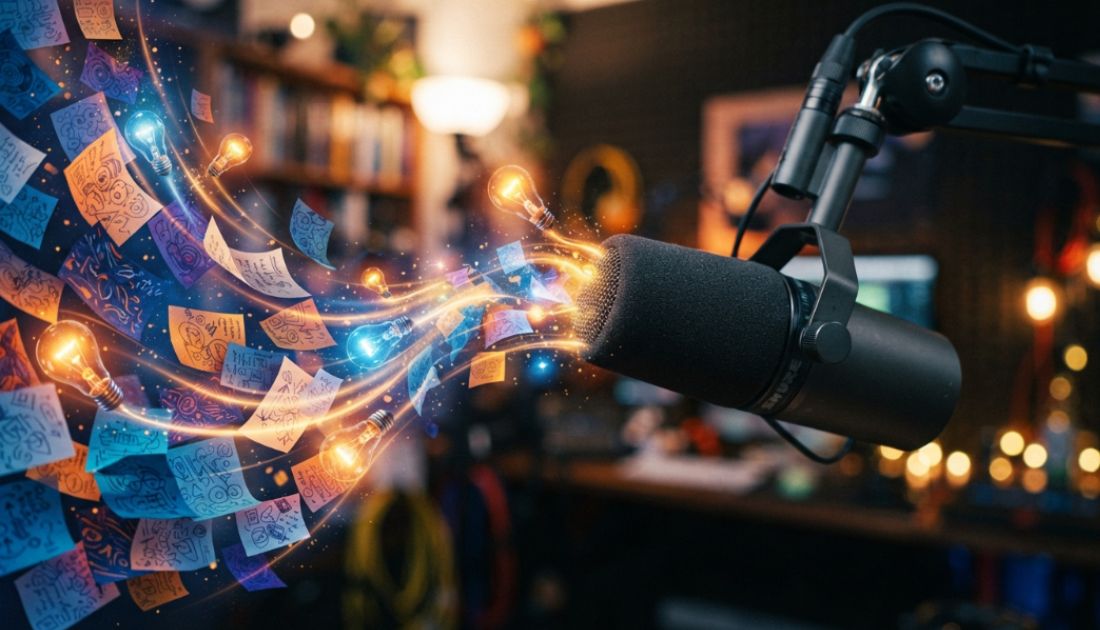
Most students are likely to take a whole lot of notes throughout lectures, meetings, study sessions, research projects, etc. The major issue often is that despite having well-written notes, one cannot spend enough time and effort to go through them one more time. The feature to Turn Notes Into Podcast gives one of the easiest forms of content creation, which allows written material to be converted into audio format. Learners can therefore have their material playing as they go for walks, commute by bike, or do their workouts.
What Is the Concept of Turning Notes Into Podcasts?
Turning Notes Into Podcast is nothing more than taking notes written digitally or by hand and turning them into a voice note or a conversation. The AI or tool doesn’t read word for word in the original note. Instead, they can gather and group important pieces of writing to make the output more like a discussion.
Imagine a student who has taken notes on a biology chapter and wants to make his notes sound like a podcast of his own voice. This means his audio could describe the life of different species in very simple language, highlight the scientists involved in each research project, and show the relation between all major topics. It can be so much different from studying that even just a short listening period gives fresh energy to students.
The Reasons to Turn Notes Into Podcasts
One of the advantages of a note-to-audio format is flexibility. Visual input reading requires you to be sitting and watching the page, whereas for a visual input, one can just sit and see while reading the document. In contrast, auditory learning can occur in a variety of situations, as the information can be passed to the learning individual through other channels. A student can even learn a lesson through a recorded audio file as they travel to a classroom or take a lunch break from digital work.
AI’s Role in Enhancing the Workflow
Producing a podcast without the use of any tool is a real task, which is mainly the script, recording, editing, and finally saving the file. An application of AI in these tasks can significantly help reduce and make them very easy. Once the notes have been finalized, the user simply leaves the document and let the AI take over the following steps: first, the AI will transcribe the text into a script that you can read without any difficulty. After that, the same AI will generate a voice of the script that comes from AI.
Beneficial for a Variety of People
Turning notes into a podcast is not only a good idea for study but can also be used by the working class to review meeting notes, training sessions, research reports, or industry knowledge they can’t keep pace with, etc.
Students are able to create audio lessons out of their lecture notes, revision guides, or even summaries of their textbooks. Language learners can also get their fill by repeatedly listening to words and explanations in the learning materials.
Getting Better Results By Learning In Audio Format?
Organizing is an important factor if you wish to convert notes into a successful podcast. A great podcast starts with a welcome, consists of a few sections, and includes an explanation that the audience will find very easy to digest. It may happen that very long podcasts lead to loss of attention and the mind wanders off, so you might try splitting the big topic into small ones and making them into little Turn Notes Into Podcast episodes.
Conclusion
Producing turn notes into podcasts is an efficient form of converting written materials or other kinds of visual texts to auditory ones, which will help them become more comprehensible or appealing. Students can change notes for lectures and so on into an audio medium, whereas professionals are advised at the same time that it can also help them to carry on a sort of training, etc. AI makes the generation much easier, but content will need checking as to whether there are errors or unclear messages by the creators. Turn Notes Into Podcast as an audio learning device will be able to give the user a variety of options of learning when it is combined with other techniques such as reading, active recall, etc.
People Read Also: Sophia Learning Cheat Sheet: A Simple Guide to Smarter Online Study
