

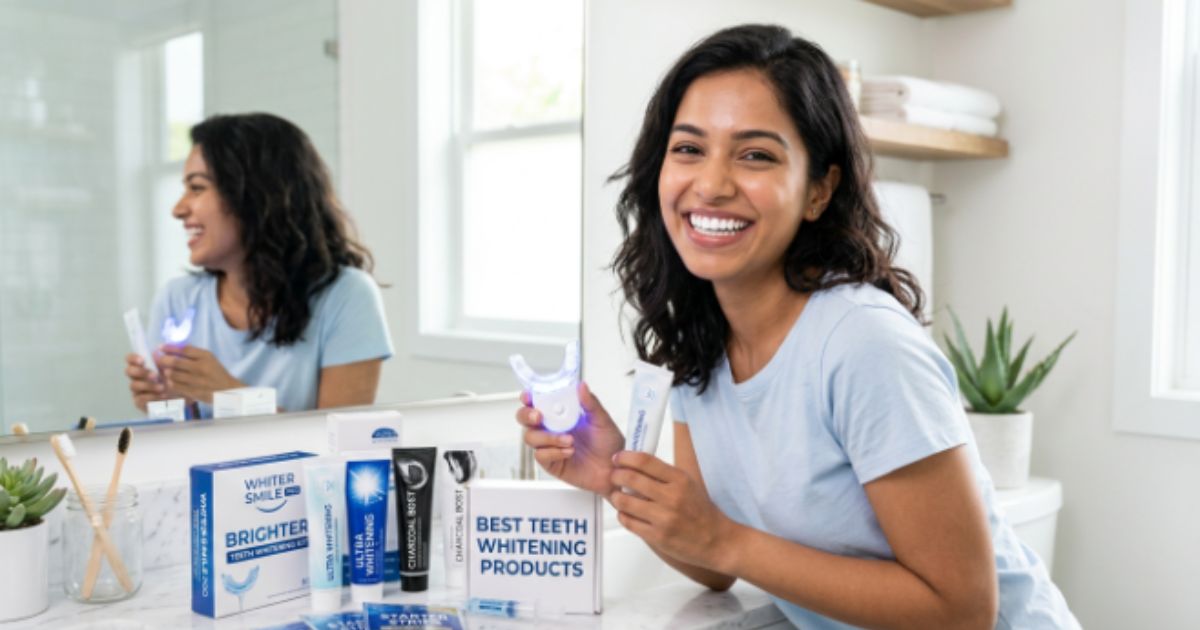
A bright smile can change how you feel about yourself. If coffee, tea, tobacco, or aging has left your teeth looking dull, choosing the best teeth whitening products can help restore a cleaner, brighter appearance. Today, you can find many options, from whitening strips and toothpaste to at-home teeth whitening kits and professional treatments. However, not every product works the same way.
Some mainly remove surface stains, while others use peroxide to lighten deeper discoloration. Your sensitivity, stain type, budget, and desired results all matter. This guide compares popular whitening options and explains their ingredients, effectiveness, safety, and proper use. With the right information, you can choose a whitening solution that fits your smile.
What Are the Best Teeth Whitening Products?
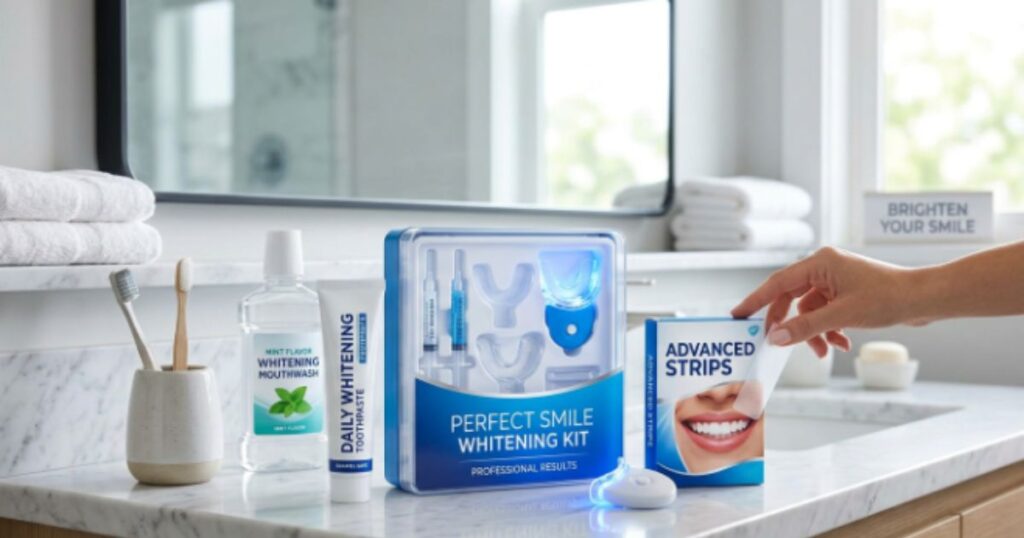
The best teeth whitening products are those that match your staining pattern and whitening goals. For mild surface stains, a quality whitening toothpaste can help with everyday stain removal. Whitening strips offer stronger cosmetic whitening for many people, while a teeth whitening kit, whitening gel, or professional tray system can provide a more intensive teeth whitening treatment. For people who need rapid results or have complicated discoloration, professional teeth whitening may provide a more predictable option.
The American Dental Association explains that whitening can address both extrinsic and intrinsic staining. Common active ingredients include hydrogen peroxide and carbamide peroxide. Temporary sensitivity and gum inflammation remain among the most common side effects of vital tooth whitening. The ADA also evaluates certain home-use bleaching products for safety and efficacy through its Seal program.
| Product type | Best suited for | Main whitening approach | Typical result pattern |
| Whitening toothpaste | Light surface stains | Abrasive and chemical stain removal | Gradual |
| Whitening mouthwash | Maintenance | Low-level whitening and stain control | Gradual |
| Whitening strips | Common coffee and tea stains | Peroxide-based whitening | Noticeable over a treatment course |
| Whitening pen | Small touch-ups | Brush-on peroxide gel | Targeted |
| Whitening trays | More intensive home whitening | Peroxide gel | Moderate to strong |
| LED teeth whitening kit | At-home convenience | Gel plus mouthpiece or LED light | Varies by formula |
| Professional whitening | Faster, stronger whitening | Dentist-controlled bleaching | Faster and more predictable |
Best Teeth Whitening Products for 2026
For 2026, the strongest buying strategy is to compare product ingredients, peroxide strength, treatment time, comfort, evidence, and safety rather than choosing a product simply because it promises the fastest whitening. Among widely recognized options, Crest 3D Whitestrips remain an important OTC category example because the ADA’s published Seal materials include several Crest whitening strip products. A dentist-dispensed system such as Opalescence can make sense when you want professional guidance and a more customized approach. The best option still depends on your teeth rather than the brand name alone.
For a practical teeth whitening comparison, think of the market as three levels. Whitening toothpaste and mouthwash sit at the gentle end and work mainly on external staining. OTC strips, pens, and kits provide a stronger middle ground. Dentist-supervised trays and in-office teeth whitening sit at the professional end. A simple comparison helps show why there isn’t one universal winner.
| Whitening option | Whitening power | Convenience | Sensitivity potential | Best use |
| Whitening toothpaste | Low | Very high | Low | Daily maintenance |
| Whitening mouthwash | Low | Very high | Low | Maintenance |
| Whitening strips | Moderate | High | Moderate | Everyday cosmetic whitening |
| Whitening pen | Low to moderate | Very high | Moderate | Touch-ups |
| Home whitening kit | Moderate | Moderate | Moderate | More noticeable home whitening |
| Take-home professional whitening | Moderate to high | Moderate | Moderate | Customized whitening |
| In-office whitening | High | Lower | Moderate to high | Fast results |
Best At-Home Teeth Whitening Products
At-home teeth whitening has become popular because it gives you more control over your schedule. Whitening strips are especially convenient because they require no tray molding or dental appointment. A teeth whitening pen can work well for small touch-ups. A tray-based teeth whitening system can provide broader contact with the teeth. Some systems also combine a whitening serum, LED light, and mouthpiece. However, the active whitening ingredient matters more than flashy hardware. Peroxide is responsible for much of the actual bleaching action in many effective systems.
When comparing OTC teeth whitening, look beyond advertising language. Check the active ingredient, instructions, treatment duration, and any available third-party evidence. The ADA recognizes home-use tooth bleaching as a product category and notes that accepted products must meet its requirements for safety and efficacy. A good at-home product should fit your routine without encouraging excessive wear time or repeated applications beyond the manufacturer’s instructions.
| At-home product | Main strength | Main limitation | Good choice when |
| Whitening strips | Simple and portable | Can cause temporary sensitivity | You want visible home whitening |
| Whitening toothpaste | Easy daily use | Limited deep whitening | You need maintenance |
| Whitening pen | Convenient application | Less even coverage | You need touch-ups |
| Whitening gel and trays | Broad tooth coverage | More preparation | You want stronger home treatment |
| LED whitening kit | Convenient technology | LED isn’t the only factor determining results | You prefer a device-based routine |
| Take-home whitening kits | Customizable treatment | Usually cost more than strips | You want professional guidance at home |
Best At-Home Whitening Methods
The most useful at-home whitening method depends on your goal. If you mainly have coffee stains, tea stains, or other light extrinsic stains, whitening strips may offer a practical balance between price and visible whitening. If you have sensitive teeth, a gentler formula or shorter treatment schedule may make more sense. For more persistent staining, teeth whitening trays containing peroxide gel can offer more consistent contact across the tooth surfaces. Pre-filled trays provide convenience, while custom-fitted trays offer a closer fit when supplied by a dental professional.
Best Teeth Whitening Products for Sensitive Teeth
If you have sensitive teeth, choosing the strongest whitening product isn’t usually the smartest move. Teeth whitening sensitivity often increases as peroxide exposure becomes stronger or longer. The ADA notes that temporary sensitivity is common with bleaching and can be more prevalent at higher active-agent concentrations. It also notes that sensitivity generally appears early in treatment and often resolves after treatment stops. A sensitivity-friendly whitening routine should therefore focus on reasonable strength, correct wear time, and careful sensitivity management.
Look for formulas that include ingredients commonly used in sensitivity-focused oral care, such as potassium nitrate and fluoride, while remembering that these ingredients don’t turn an aggressive whitening treatment into a risk-free one. Some products use low-concentration peroxide or non-peroxide approaches. A whitening toothpaste containing hydrated silica can help polish away surface stains without functioning like a high-strength bleaching treatment. ADA-accepted sensitivity toothpastes are evaluated for their stated benefits when used as directed.
| Sensitive-teeth concern | More cautious approach | Why it may help |
| Mild sensitivity | Whitening toothpaste | Focuses on surface stain removal |
| Moderate sensitivity | Lower-strength whitening product | Reduces peroxide exposure |
| Sensitivity during strips | Reduce exposure according to product guidance | Gives teeth more recovery time |
| Gum discomfort | Check product fit and application | Limits gel contact with gums |
| Persistent pain | Stop whitening and seek dental advice | Pain may have another cause |
| Existing dental problems | Dentist consultation | Whitening may not address the underlying issue |
Gentle Whitening for Sensitive Enamel
Gentle whitening works best when you treat whitening as a gradual process rather than a race. A lower-strength product may take longer to produce visible changes, but that trade-off can make the routine easier to tolerate. Ingredients such as nano-hydroxyapatite appear in some modern oral-care products, while fluoride remains an established ingredient for cavity protection. The ADA notes that whitening products can produce temporary sensitivity and that people with existing sensitivity should discuss whitening risks and benefits with a dentist.
Hydrogen Peroxide vs. Carbamide Peroxide: Which Is Better?
Hydrogen peroxide and carbamide peroxide are the two major peroxide-based bleaching agents used in teeth whitening. Hydrogen peroxide acts directly as the bleaching compound. Carbamide peroxide breaks down into hydrogen peroxide and urea, which means it releases hydrogen peroxide more gradually. That’s one reason carbamide peroxide frequently appears in at-home tray systems. Neither ingredient automatically wins for every person. The ideal choice depends on concentration, contact time, treatment design, stain type, and sensitivity.
Research also shows why concentration shouldn’t be treated as a simple “stronger is better” equation. A systematic review found that lower hydrogen peroxide concentrations can reduce sensitivity while still producing meaningful color change in some in-office protocols. Another 2024 systematic review found that high-concentration carbamide peroxide may produce similar whitening to high-concentration hydrogen peroxide in certain in-office protocols, although the researchers emphasized that the evidence had important limitations.
| Feature | Hydrogen peroxide | Carbamide peroxide |
| Action | Direct peroxide bleaching | Releases hydrogen peroxide gradually |
| Common use | OTC products and professional whitening | Many tray-based systems |
| Speed | Often faster acting | Often more gradual |
| Sensitivity | Depends on concentration and exposure | Depends on concentration and exposure |
| Best choice | Depends on treatment design | Depends on treatment design |
How to Choose the Best Teeth Whitening Product
Choosing the best teeth whitening products starts with your stain rather than the package. Surface stains caused by coffee, tea, tobacco, or red wine may respond well to toothpaste, strips, or other OTC products. Intrinsic stains can develop from aging, certain medications, fluorosis, or dental trauma. These deeper changes can be more difficult to treat at home. Mixed stains may contain both surface and deeper discoloration, making a dental evaluation especially useful.
Next, consider whitening strength, peroxide concentration, treatment time, comfort, and cost. Check the product expiration date before buying or using an older kit. Look for clear product ingredients and straightforward directions. The ADA Seal of Acceptance can also provide useful third-party information because the program evaluates submitted evidence for safety and efficacy within specific product categories.
| What to compare | What to look for | Why it matters |
| Stain type | Extrinsic, intrinsic, or mixed | Determines suitable treatment |
| Active ingredient | Hydrogen peroxide or carbamide peroxide | Drives bleaching action |
| Peroxide concentration | Appropriate strength | Affects speed and sensitivity |
| Treatment time | Clear wear time | Helps prevent overuse |
| Sensitivity | Sensitive-teeth formula | Improves comfort |
| Evidence | ADA Seal or clinical evidence | Adds confidence |
| Cost | Product and replacement cost | Helps with long-term value |
| Expiration | Current product expiration date | Supports product performance |
| Fit | Strips, trays, mouthpiece, or pen | Affects coverage and comfort |
Choosing Whitening Products for Your Tooth Color
Your natural tooth color also matters. Teeth aren’t naturally paper-white, and the goal of whitening is usually to lighten the existing shade rather than create an artificial-looking result. If your teeth have yellow teeth caused by normal aging, whitening may produce a noticeable change. However, restorations such as crowns, veneers, and fillings don’t whiten in the same way as natural teeth. The ADA specifically notes that whitening products whiten natural teeth rather than tooth-colored restorations.
Do Teeth Whitening Products Really Work?
Yes, whitening products can work, but different products do different jobs. Whitening toothpaste generally focuses on removing or reducing external discoloration. Whitening strips, gels, and trays can deliver peroxide to the tooth surface for a longer period. Peroxide-based products can oxidize stain molecules, which changes the compounds responsible for darker tooth color. This makes peroxide-based whitening different from simple polishing or stain removal.
The biggest mistake is expecting every product to deliver the same whitening effectiveness. A toothpaste isn’t designed to behave like professional bleaching. A whitening pen isn’t designed to cover every tooth as evenly as a tray. An OTC kit may require repeated sessions. Professional teeth whitening can deliver faster results because dental professionals can use controlled protocols and stronger formulations. The ADA notes that in-office procedures, dentist-supplied home products, and OTC products are all established whitening approaches.
| Product | What it can realistically do |
| Whitening toothpaste | Remove or reduce many surface stains |
| Whitening mouthwash | Support gradual stain control and oral care |
| Whitening strips | Produce visible bleaching with consistent use |
| Whitening pen | Provide targeted touch-up whitening |
| Whitening trays | Deliver peroxide across multiple teeth |
| LED teeth whitening | Combine a device with a whitening formulation |
| Professional whitening | Provide controlled, higher-intensity treatment |
Why Results Differ From Person to Person
Two people can use the same product and see different whitening results. One person may have recent coffee stains, while another has age-related discoloration or medication-related changes inside the tooth. The first case may respond quickly to OTC whitening. The second may require a more customized plan. Dental restorations create another complication because whitening changes natural tooth color but doesn’t necessarily change the shade of crowns, veneers, or fillings.
Teeth Whitening Safety, Side Effects, and Risks
Whitening safety starts with following the product directions. The most common whitening side effects include temporary tooth sensitivity and gum irritation. The ADA reports that sensitivity can occur with different forms of bleaching and may become more likely as active-agent concentration increases. Applying too much whitening gel, extending wear time, or using a product more frequently than directed isn’t a shortcut to a perfect smile. It can simply increase discomfort.
Before whitening, consider your overall oral health. Cavities, gum problems, cracked teeth, exposed roots, or unexplained dental pain may need attention first. People with crowns, veneers, or fillings should also understand that natural teeth and restorations can respond differently. A dentist consultation can identify problems that a whitening product cannot fix. For people with significant sensitivity, dentist supervision can make the process more controlled and predictable.
| Possible concern | What it means | Safer response |
| Temporary sensitivity | Teeth feel uncomfortable with cold or hot foods | Follow product directions and consider a gentler approach |
| Gum irritation | Whitening material contacts soft tissue | Improve application and avoid excess gel |
| Uneven whitening | Different teeth respond differently | Consider professional assessment |
| Existing restorations | Crowns or veneers may not whiten | Discuss shade matching with a dentist |
| Deep discoloration | Internal stain may resist OTC products | Consider professional evaluation |
| Persistent pain | May indicate another dental issue | Stop whitening and seek dental care |
How to Minimize Teeth Whitening Sensitivity
To minimize sensitivity, don’t assume more peroxide automatically means better whitening. Choose an appropriate strength, respect the recommended wear time, and avoid stacking several whitening products at once unless a dental professional recommends the combination. A sensitive teeth formula may be more suitable when discomfort is already an issue. If sensitivity becomes severe or persists after stopping treatment, a dental examination can help determine whether something other than whitening is responsible.
Professional Teeth Whitening vs. At-Home Products
Professional teeth whitening gives you the advantage of a dental examination, controlled application, and customized treatment. During in-office teeth whitening, a dental professional can protect the gums and monitor the treatment. Some offices offer systems such as Zoom whitening, Opalescence, or other professional bleaching approaches. Laser teeth whitening is another term used in the cosmetic dentistry market, although the exact technology and protocol vary by provider. The important factor isn’t the marketing label. It’s the controlled whitening treatment and appropriate use of bleaching agents.
At-home teeth whitening offers convenience and usually costs less than in-office treatment. Store-bought strips and kits can be useful for many people with uncomplicated surface staining. Dentist-provided take-home whitening kits can offer another middle ground. These often use custom whitening trays and professional-strength gel while allowing you to complete the treatment at home. The ADA recognizes dentist-supplied home whitening as an established approach and notes that custom-fitted trays can be used with professional-strength bleaching gel.
| Factor | At-home whitening | Professional whitening |
| Convenience | High | Requires appointment |
| Cost | Usually lower | Usually higher |
| Speed | Gradual to moderate | Often faster |
| Customization | Depends on product | High |
| Dentist supervision | Usually absent with OTC products | Present |
| Complex stains | May be limited | Better suited for evaluation |
| Sensitivity management | User-managed | Professionally monitored |
| Best for | Routine cosmetic whitening | Faster or customized treatment |
When Professional Whitening Makes More Sense
Professional treatment becomes more attractive when you need fast results, have stubborn deep stains, have uneven discoloration, or want a treatment plan built around existing dental work. It can also make sense when previous whitening attempts caused significant sensitivity. A dental professional can examine the teeth first and determine whether bleaching is appropriate. In some cases, the best “whitening product” isn’t a stronger product at all. It’s the correct diagnosis followed by the right treatment.
How Long Do Teeth Whitening Results Last?
Whitening duration varies considerably from person to person. Your diet, smoking habits, oral hygiene, natural tooth color, and maintenance routine all affect how long the teeth remain bright. Someone who drinks several cups of coffee every day may notice new staining sooner than someone who rarely consumes dark beverages. That’s why whitening maintenance matters almost as much as the original treatment.
Think of whitening like cleaning a white shirt. You can remove the existing stain, but repeated exposure to coffee, tea, tobacco, or red wine can gradually bring discoloration back. Long-lasting results therefore depend on sensible maintenance rather than constant bleaching. After a treatment course, some people may use periodic touch-ups or maintenance products according to product instructions or a dentist’s recommendation. The ADA also notes that whitening results are not permanent and that maintenance may be needed.
| Factor | Effect on whitening longevity |
| Coffee and tea | Can contribute to new surface stains |
| Red wine | Can contribute to external discoloration |
| Tobacco and smoking | Can accelerate staining |
| Oral hygiene | Helps control plaque and surface discoloration |
| Maintenance whitening | Can help preserve the desired shade |
| Natural aging | Gradually changes tooth appearance |
| Product type | Affects initial whitening and maintenance needs |
| Diet | Influences future staining |
Building a Whitening Maintenance Routine
A sensible maintenance whitening plan should focus on prevention first. Continue regular brushing and flossing, maintain good oral hygiene, and follow the instructions for any whitening toothpaste or touch-up product. Don’t keep repeating an intensive teeth whitening treatment simply because you want an even brighter shade. Your natural teeth have limits, and chasing an endlessly lighter color can turn a cosmetic goal into an unnecessary source of tooth discomfort or gum irritation.
Final Verdict:
The best teeth whitening products depend on what you need from the treatment. For everyday surface stain control, whitening toothpaste can be a convenient choice. For more visible OTC whitening, strips and peroxide-based kits can provide a stronger option. People who prefer customized treatment can consider teeth whitening trays or take-home professional whitening, while those seeking the quickest transformation may prefer in-office teeth whitening after a dental evaluation.
The smartest choice is rarely the product with the biggest promise on the package. Instead, look at the whitening ingredients, peroxide strength, treatment time, sensitivity risk, evidence, price, and expiration date. For people with healthy natural teeth and uncomplicated staining, an appropriate OTC product may be enough. When you have persistent discoloration, dental restorations, significant sensitivity, or unexplained tooth changes, dentist-recommended teeth whitening can provide a safer and more personalized path toward a brighter smile, whiter teeth, and greater smile confidence.
FAQ’s About Best Teeth Whitening Products
What is the most effective product to whiten teeth?
Peroxide-based whitening strips, trays, and professional whitening treatments are generally among the most effective options. Professional treatments usually deliver the fastest and strongest results.
What whitens your teeth immediately?
In-office teeth whitening can make teeth noticeably brighter after a single session. Most at-home products need several days or weeks for visible results.
Can yellow teeth really be whitened?
Yes. Yellow teeth can often be whitened, especially when discoloration comes from surface stains or aging. Deep stains may need professional treatment.
Which teeth whitening do dentists recommend?
Dentists commonly recommend peroxide-based whitening products, including whitening strips, custom trays, and professional treatments, depending on your teeth and sensitivity.
Do any teeth whitening products actually work?
Yes. Whitening products containing hydrogen peroxide or carbamide peroxide can effectively lighten teeth when used correctly and consistently.
People Read Also: Calculating Depreciation on Equipment: Methods, Formula, Examples & Complete Guide

My name is M.Adil, I am specialize in creating thoughtful digital content that informs, inspires, and engages readers worldwide. Every piece is written with care and originality.