

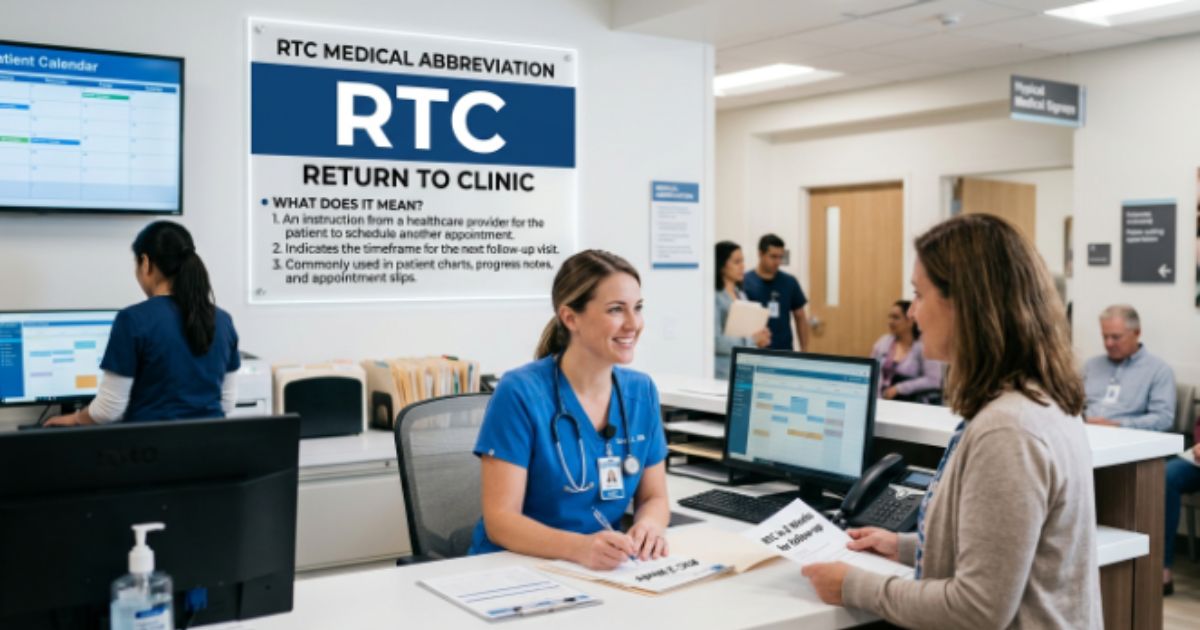
Seeing RTC Medical Abbreviation in a medical record can be confusing, especially when you don’t know what the letters mean. In many healthcare settings, RTC commonly refers to Return to Clinic, which tells a patient to come back for another visit or follow-up. However, RTC can have different meanings depending on the clinical context, medical specialty, and type of record.
It may also refer to a Residential Treatment Center in mental health care or a Road Traffic Collision in emergency medicine. Understanding the words around RTC can help you identify the correct medical terminology and avoid confusion. In this guide, you’ll learn the meanings, uses, examples, and contexts of RTC in healthcare.
What Does RTC Mean in Medical Terms?
The most common RTC Medical Abbreviation meaning in outpatient medicine is Return to Clinic. It tells a patient to come back for another visit. The visit may happen after a specific period. It may also happen when the patient needs further evaluation or care. For example, RTC in 2 weeks usually means that the patient should return to the clinic two weeks later.
The abbreviation doesn’t describe a disease or diagnosis. Instead, it usually describes a next step in patient care. A healthcare provider may use RTC after reviewing symptoms, starting treatment, performing a procedure, or ordering tests. The provider may want to check the patient’s condition during a later medical visit. The exact purpose depends on the complete treatment plan.
Common RTC Meanings in Healthcare
| RTC Meaning | Common Healthcare Setting | General Meaning |
| Return to Clinic | Outpatient care | Come back for another medical visit |
| Residential Treatment Center | Behavioral health | Live-in mental health or addiction treatment |
| Road Traffic Collision | Emergency medicine | A collision involving road traffic |
These meanings show why medical abbreviations need context. A patient reading RTC in a clinic note will usually encounter Return to Clinic. Someone reading a trauma report may see Road Traffic Collision instead. Likewise, a behavioral health record may use RTC for Residential Treatment Center.
RTC in Medical Notes, Charts, and Doctor’s Instructions
You may find RTC in medical charts in several types of clinical documentation. It can appear in clinical notes, appointment plans, progress reports, and discharge instructions. It may also appear inside electronic medical records. Healthcare teams often use familiar healthcare abbreviations to keep routine documentation brief.
The surrounding words usually explain what the abbreviation means. For example, RTC in doctor’s notes followed by “in 1 week” strongly suggests a planned follow-up. A phrase such as “RTC after lab results” also points toward a return visit. These patient instructions are part of the broader care plan.
Examples of RTC in Medical Documentation
| Example | Likely Meaning |
| “RTC in 1 week” | Return to the clinic in one week |
| “RTC in 2 weeks for follow-up” | Return for a planned follow-up |
| “RTC after test results” | Return after results become available |
| “RTC PRN” | Return to clinic as needed |
| “Patient involved in RTC” | Could mean Road Traffic Collision in trauma care |
Good medical terminology doesn’t exist in isolation. The sentence, specialty, and type of record all matter. If the wording remains unclear, ask the healthcare team rather than guessing.
What Does “Return to Clinic” Mean?
Return to Clinic means that your healthcare provider wants you to come back for another medical visit. The follow-up may help the provider check your recovery. It may also help review test results or adjust treatment. In simple terms, RTC means that your current visit isn’t necessarily the final step in your care.
A RTC follow-up can happen for many reasons. Your provider may want to monitor symptoms, check healing, review medication effects, or discuss a test result. The provider may also need to decide whether your current treatment should continue. The abbreviation itself doesn’t explain the reason. Your complete treatment plan provides that information.
Why Do Healthcare Providers Schedule Follow-Up Visits?
| Reason for Follow-Up | What May Happen |
| Symptom monitoring | The provider checks whether symptoms improved |
| Medication review | The provider checks benefits and side effects |
| Test results | Results are discussed and explained |
| Injury recovery | Healing and function are assessed |
| Treatment adjustment | The care plan may change |
A scheduled follow-up appointment gives both you and the provider another opportunity to assess progress. This can be especially useful when a condition changes over time. It also allows the provider to respond if your needs change.
Common RTC Follow-Up Instructions and Timeframes
RTC follow-up instructions often include a timeframe. The timeframe tells you when the provider expects another visit. For example, RTC in 1 week means you generally need to return about one week later. Similarly, RTC in 2 weeks usually means a follow-up appointment should happen two weeks later.
The timing depends on the patient’s condition and the reason for follow-up. Some patients may need a quick review. Others may need several months before another assessment. A provider may also tell you to return sooner if symptoms worsen. The complete doctor’s instructions should always take priority over a general explanation of an abbreviation.
Understanding Common RTC Timeframes
| RTC Instruction | General Meaning |
| RTC in 1 week | Return for care in about one week |
| RTC in 2 weeks | Return for care in about two weeks |
| RTC in 4 weeks | Return for care in about four weeks |
| RTC in 3 months | Return for care in about three months |
| RTC for follow-up | Return for another planned evaluation |
| RTC after testing | Return after the specified testing |
| RTC PRN | Return to clinic as needed |
The timeframe doesn’t always explain why you need the visit. For that reason, read the entire note instead of focusing only on RTC. If the date isn’t clear, contact the clinic and confirm the follow-up timeframe.
RTC PRN and Other Medical Abbreviations Related to Follow-Up
RTC PRN usually means Return to Clinic as needed. Here, RTC describes returning to the clinic. PRN means that the patient should seek another visit when needed. The specific reason for returning should appear elsewhere in the medical instructions.
Many common medical abbreviations appear alongside follow-up instructions. For example, providers may use terms related to follow-up, rechecks, or as-needed care. These abbreviations can make clinical documentation shorter. However, they can also make medical records harder for patients to understand.
RTC PRN vs. Scheduled Follow-Up
| Instruction | General Idea |
| RTC in 2 weeks | A planned return visit |
| RTC PRN | Return when further care is needed |
| Follow-up in 1 month | A scheduled future review |
| Return sooner if needed | Seek care earlier under stated circumstances |
As-needed care doesn’t mean you should ignore concerning symptoms. It means the provider hasn’t necessarily set a fixed routine visit. If your instructions aren’t clear, ask your healthcare provider what symptoms or circumstances should prompt you to return for care.
RTC in Different Medical Contexts: Why the Meaning Can Change
The same three letters can represent different ideas across a healthcare setting. That’s why abbreviation context matters. In outpatient care, RTC usually means Return to Clinic. In behavioral health, it can mean Residential Treatment Center. In emergency medicine, RTC can refer to Road Traffic Collision.
Think of RTC like a word with several meanings in everyday language. You understand the intended meaning by looking at the sentence around it. Healthcare works in much the same way. The specialty, document type, and surrounding medical terminology help reveal the correct meaning.
RTC Meaning by Medical Context
| Medical Context | Possible RTC Meaning | Key Clues |
| Outpatient care | Return to Clinic | Follow-up, appointment, timeframe |
| Behavioral health | Residential Treatment Center | Therapy, live-in treatment, recovery |
| Addiction treatment | Residential Treatment Center | Substance use, recovery, structured care |
| Emergency medicine | Road Traffic Collision | Trauma, accident, vehicle, injury |
| Trauma care | Road Traffic Collision | Collision details, emergency assessment |
This comparison can prevent a common mistake. Don’t assume that every RTC in a medical record means the same thing. Clinical context is the deciding factor.
RTC as Residential Treatment Center in Mental Health and Addiction Care

In mental health treatment and addiction treatment, RTC can mean Residential Treatment Center. This is a treatment facility where people live while receiving structured care. Unlike ordinary outpatient care, residential treatment provides a more immersive environment. The person stays at the facility while receiving therapeutic services.
A Residential Treatment Center may support people with mental health issues, substance use concerns, or co-occurring conditions. Services can include counseling, individual therapy, group therapy, and family therapy. Depending on the program, residents may also receive medical oversight, skills training, and recovery support. The level of care varies between facilities.
What Happens in Residential Treatment?
| Service | General Purpose |
| Individual therapy | Explore personal concerns and coping strategies |
| Group therapy | Build support and practice communication |
| Family therapy | Improve family communication and relationships |
| Counseling | Address emotional or behavioral concerns |
| Life-skills training | Build practical daily living skills |
| Medical supervision | Monitor health and treatment needs |
| Recovery support | Strengthen long-term recovery skills |
Residential care can provide structure when outpatient services don’t offer enough support. However, admission decisions depend on an individual medical assessment and professional recommendations. A Residential Treatment Center isn’t automatically the right choice for everyone.
RTC as “Road Traffic Collision” in Emergency and Trauma Care
In emergency medicine and trauma care, RTC can mean Road Traffic Collision. This meaning describes a collision involving road traffic. Healthcare professionals may use it when documenting the circumstances surrounding an injury. The abbreviation can appear in an emergency department record or trauma report.
This meaning differs sharply from Return to Clinic. Imagine a patient arrives after a vehicle collision. An emergency note may mention an RTC while describing the patient’s injuries and emergency assessment. In that setting, the surrounding details point toward a road traffic event rather than a future appointment.
How Trauma Notes Provide Context
A trauma record may discuss the type of collision, the patient’s injuries, symptoms, examination findings, and treatment. Those details make the intended meaning easier to identify. If RTC appears next to words such as accident, vehicle, collision, or trauma, Road Traffic Collision may be the intended meaning.
By contrast, a phrase such as “RTC in 2 weeks” usually relates to follow-up. The surrounding language acts like a signpost. It guides you toward the correct abbreviation meaning without changing the actual medical facts.
How to Tell Which RTC Meaning Applies to a Medical Note
Start with the words immediately surrounding RTC. If you see a timeframe such as “in 2 weeks,” the abbreviation probably means Return to Clinic. If you see therapy, residential care, or addiction services, Residential Treatment Center may fit. If the note discusses an accident or trauma, Road Traffic Collision may be more likely.
Next, consider the type of record. An outpatient progress note has a different purpose from an emergency trauma report. A behavioral health admission document also uses different language. This simple approach can help you interpret many abbreviations without jumping to conclusions.
Quick RTC Context Guide
| If the Note Mentions… | RTC May Mean… |
| Follow-up appointment | Return to Clinic |
| RTC in 2 weeks | Return to Clinic |
| RTC PRN | Return to Clinic |
| Residential program | Residential Treatment Center |
| Mental health treatment | Residential Treatment Center |
| Substance abuse treatment | Residential Treatment Center |
| Accident or collision | Road Traffic Collision |
| Emergency trauma | Road Traffic Collision |
The key is to consider the entire medical chart rather than one abbreviation. If you still can’t determine the meaning, ask the person responsible for the record. A quick question can remove a lot of uncertainty.
When Should You Ask a Healthcare Professional About RTC?
You should ask a healthcare professional whenever RTC or another abbreviation leaves you unsure about what to do. This matters most when the note contains an appointment date, medication instruction, testing requirement, or other important patient care direction. Never rely on a general online definition when your personal instructions remain unclear.
Your healthcare provider can explain exactly what RTC means in your record. You can ask when to return, why another visit is needed, and whether you should schedule the appointment yourself. If the note says RTC PRN, ask what situations require another visit. Clear communication makes follow-up care easier to understand.
Questions You Can Ask About an RTC Note
| Question | Why It Helps |
| “What does RTC mean here?” | Confirms the intended abbreviation |
| “When should I return?” | Clarifies the appointment timing |
| “Do I need to schedule the visit?” | Prevents missed follow-up |
| “What is the follow-up for?” | Explains the purpose of the visit |
| “Should I return sooner if symptoms change?” | Clarifies urgent follow-up instructions |
Key Takeaways About the RTC Medical Abbreviation
The RTC Medical Abbreviation most commonly means Return to Clinic in outpatient medical documentation. You may see it in medical records, clinical notes, appointment plans, and discharge paperwork. Phrases such as RTC in 1 week, RTC in 2 weeks, and RTC PRN usually describe follow-up care.
However, RTC can mean something different in another healthcare setting. A behavioral health program may use it for Residential Treatment Center. An emergency or trauma service may use it for Road Traffic Collision. The surrounding words provide the most useful clue.
Conclusion
The meaning of the RTC Medical Abbreviation depends heavily on context. In most outpatient notes, RTC means Return to Clinic. It tells you to come back for another medical visit or follow-up. Instructions such as RTC in 2 weeks provide a specific follow-up timeframe, while RTC PRN generally means return to clinic as needed.
Still, RTC has other important meanings. In behavioral health, it can mean Residential Treatment Center. In emergency medicine and trauma care, it can mean Road Traffic Collision. Looking at the surrounding words can usually reveal which meaning applies. When an instruction remains unclear, asking a qualified healthcare professional is the safest way to understand your medical record.
FAQ’s About RTC Medical Abbreviation
What does RTC mean on a medical report?
RTC usually means Return to Clinic, telling you to come back for a follow-up appointment. Its meaning can vary by medical context.
What does RTC stand for?
RTC can stand for Return to Clinic, Residential Treatment Center, or Road Traffic Collision, depending on the context.
What does RTC stand for in medical terms?
In many medical notes, RTC means Return to Clinic, which refers to a planned follow-up visit with a healthcare provider.
What does RTC stand for in physical therapy?
In physical therapy, RTC commonly means Return to Clinic, indicating that the patient should return for another therapy or follow-up visit.
What does “RTC” stand for in medical terms?
RTC most commonly stands for Return to Clinic in outpatient medical documentation, but the exact meaning depends on the surrounding note.
People Read Also: Photography Lighting Basics: A Complete Beginner’s Guide

My name is M.Adil, I am specialize in creating thoughtful digital content that informs, inspires, and engages readers worldwide. Every piece is written with care and originality.